

Triaging the Week 123
AI: Both the Weapon and the Weak Link // Trusted Channels Weaponized // Covert Surveillance // Critical Exploits & Active Campaigns // The Future of Vulnerability Management

Hello there 👋
Welcome back to the Kraven Security weekly newsletter, triaging the week. We round up the week's top news stories, highlight our featured article, give you some learning resources, and finish with a few personal notes about what’s happening at the company. Enjoy!
Top News Stories

AI: Both the Weapon and the Weak Link
Stories
🗞️ AI Coding Assistants Weaponized: Miasma Worm Breaches 73 Azure GitHub Repositories — A self-replicating supply-chain worm pushed malicious commits to 73 Microsoft repos, planting config files that auto-execute when a poisoned repo is opened in Claude Code, Cursor, Gemini CLI, or VS Code.
🗞️ Meta AI Chatbot Flaw Exploited to Seize Over 20,000 Instagram Accounts — A “High Touch Support” chatbot with backend account access but no identity verification let attackers redirect password resets and hijack 20,225 accounts over seven weeks.
🗞️ Phishing for Lobsters: How AI Agents Are Fooled by Classic Social Engineering Pretexts — Enterprise inbox-management agents spotted complex OAuth traps but collapsed under simple operational pretexts, leaking credentials and data to external actors.
Recommendations
☑️ Enforce least privilege and human-in-the-loop on AI agents — never let an autonomous agent modify security settings, transmit credentials, or email net-new recipients without human review.
☑️ Segment and isolate — agents ingesting untrusted input (inboxes, cloned repos) must be cut off from sensitive scopes (CRM, SharePoint, secret stores), and dev endpoints exposed to poisoned repos should be quarantined and swept for persistence hooks (~/.claude/settings.json, .vscode/tasks.json).
☑️ Rotate secrets and harden the identity layer — rotate tokens/PATs/SSH keys, scope OIDC to authorized workflows, and enforce branch protections plus MFA across all assets.
☑️ Treat AI workflows as a monitored attack surface — log agent actions and hardcode explicit verification rules into agent configs (agents.md).
Trusted Channels Weaponized: Phishing, Fraud & Impersonation
Stories
🗞️ Massive World Cup Fraud Uncovered: The GHOST STADIUM Threat — A pixel-perfect clone of FIFA’s SSO login harvests credentials, locks victims out via reset abuse, and runs across 11 languages targeting 2026 World Cup fans. 🔎 Threat Hunting Package
🗞️ Your Scroll Just Became a Security Risk: TikTok & Instagram Reels Are the New Phishing Frontier — “Free premium software” tutorials with 100k+ views push Vidar Stealer via PowerShell, weaponizing algorithm-amplified short-form video. 🔎 Threat Hunting Package
🗞️ NFCShare Evolves: GitHub-Hosted Android Malware Hijacks Contactless Payment Cards — An Intesa Sanpaolo-themed lure delivers a GitHub-hosted APK that abuses Host Card Emulation to clone EMV data when victims “tap to update,” relaying card and PIN for ATM withdrawals. 🔎 Threat Hunting Package
Recommendations
☑️ Refresh awareness training for new channels — staff must know a polished TikTok tutorial or a “tap your card to update the app” prompt is as dangerous as an email lure, and no legitimate vendor asks you to run PowerShell or tap a card to a phone.
☑️ Lock down endpoints — use MDM to block sideloading (verified stores only), restrict who can run PowerShell or install software, and disable NFC when it’s not in use.
☑️ Buy and verify through official channels only — type web addresses manually for tickets, merchandise, and account actions rather than following email or social links.
☑️ Get proactive on infrastructure — deploy Digital Risk Protection to catch spoofed domains and accounts for takedown, and feed published IoCs (domains, hashes) into detection today.
Covert Surveillance: Spying Through Your Own Devices
Stories
🗞️ Your Smart TV Is an Undetectable AI Scraper: Bright Data Proxy SDK Exposed — An SDK in Samsung/LG TV apps quietly turns sets into residential proxies for AI-training scrape traffic, defaulting to a 200 GB monthly budget over an unauthenticated relay. 🔎 Threat Hunting Package
🗞️ Meta Moves to Hold NSO Group in Contempt Following Renewed WhatsApp Spyware Attacks — Despite an active injunction, NSO-linked actors ran fresh WhatsApp test-group and one-click phishing campaigns against journalists and officials in Jordan and Lebanon. 🔎 Threat Hunting Package
🗞️ New FROST Attack Tracks Your App and Website Activity via SSD Timing Contention — A zero-click side-channel abuses the browser’s OPFS API to measure SSD read latency, fingerprinting open apps and sites with ~96% accuracy and no permission prompt.
Recommendations
☑️ Isolate untrusted devices — put smart TVs and IoT on a dedicated guest VLAN, audit and remove obscure apps, and use router blocklists plus data-usage monitoring to catch covert proxy traffic.
☑️ Harden high-risk users and devices — enable Lockdown Mode / maximum security constraints for journalists, execs, and diplomats, and keep mobile OS, browsers, and messaging apps aggressively patched.
☑️ Practice browser hygiene — close background tabs (FROST only tracks while the page is open) and, on Linux, keep profiles in RAM with profile-sync-daemon.
☑️ Block known infrastructure — ingest the disclosed NSO IoCs into DNS/firewall/EDR and watch for traffic to the rogue media and casting domains.
Critical Exploits & Active Campaigns: Patch and Hunt Now
Stories
🗞️ Unauthenticated Root RCE Chain Exposed in Ubiquiti UniFi OS Server — A three-part chain gives unauthenticated root in a single request with zero failed-login telemetry, exposing the JWT signing key for forged sessions that survive updates.
🗞️ New Microsoft Defender ‘RoguePlanet’ Zero-Day Grants Local SYSTEM Privileges — A public PoC exploits a local race condition in Defender to reach SYSTEM on fully patched Win10/11, with no CVE and no native definition to block it.
🗞️ ServiceNow Alerts Customers After Unauthenticated API Flaw Exposes Sensitive Enterprise Data — A misconfigured /api/now/related_list_edit/create endpoint (auth set to false) let unauthenticated actors pull tickets, asset inventories, and employee records before a June 5 fix.
🗞️ Old WinRAR Flaw Fuels Multi-Wave Cyber Campaigns Against Ukrainian Organizations — Russia-aligned UAC-0226 still exploits CVE-2025-8088 via NTFS ADS path traversal to drop nested PowerShell loaders and the GIFTEDCROOK stealer. 🔎 Threat Hunting Package
🗞️ Malicious SMTP Proxy Network Exposed: PCPJack Hijacks 230 Cloud Servers — Attackers turned 230+ compromised cloud Linux web apps into a Sliver/Chisel SMTP relay network for global smishing, using a port-587 “quality gate.” 🔎 Threat Hunting Package
Recommendations
☑️ Patch the named flaws immediately — UniFi OS Server to 5.0.8+ (appliances 5.1.10/5.1.12+), WinRAR to 7.13+, accelerate testing for the out-of-band Defender fix (monitor MSRC); confirm your ServiceNow instance took the June 5 update.
☑️ Assume compromise and rotate — where systems were exposed, rotate keys and credentials (UniFi JWT signing key, ServiceNow secrets shared in tickets, cloud secrets), force-terminate active sessions, and inspect for SSH/persistence.
☑️ Restrict exposure and egress — block external access to admin interfaces (TCP 11443), filter unexpected outbound SMTP (port 587), and confine consoles to management VLANs.
☑️ Hunt IoCs and tune EDR — sweep for ServiceNow IP 51.159.98.241 and /related_list_edit access, cloud cron/systemd xsync and /var/tmp/.xs binaries; alert on MsMpEng.exe spawning shells and double-nested PowerShell from Startup/ProgramData.
The Future of Vulnerability Management: Speed Over Volume
Stories
🗞️ AI Just Became the World’s Most Capable Pen Tester. Now It’s (Mostly) Public. — Anthropic’s Mythos-class model built working exploits from fresh CVE disclosures in under a day for a few thousand dollars in compute, collapsing the gap between “disclosed” and “weaponized.”
🗞️ CISA Overhauls Vulnerability Management: Shifting from “Patch Everything” to True Risk-Based Prioritization — A new binding directive pivots federal and critical-infrastructure patching toward internet-exposure, KEV status, and automatability rather than raw CVSS severity.
🗞️ VS Code Implements 2-Hour Extension Auto-Update Delay to Halt Supply Chain Attacks — Microsoft added a mandatory propagation lag so scanners and researchers can flag and revoke compromised marketplace extensions before they reach millions of endpoints.
Recommendations
☑️ Shrink patch windows to hours for anything internet-facing — the disclose-to-weaponize gap has collapsed, so enable auto-updates and fast-track CVEs that are internet-exposed and on the CISA KEV catalog.
☑️ Prioritize by risk, not raw severity — tier assets by business impact, isolate high-value systems, and move toward Continuous Threat Exposure Management (CTEM) instead of blanket CVSS-driven patching.
☑️ Build in buffers and curation for third-party code — favor manual approval and private registries for unverified-publisher extensions, and let engineered update delays give scanners time to catch malicious releases.
☑️ Cover the basics that buy time — MFA everywhere and logging that captures what matters, so one unpatched box isn’t your only line of defense.
Feature Video
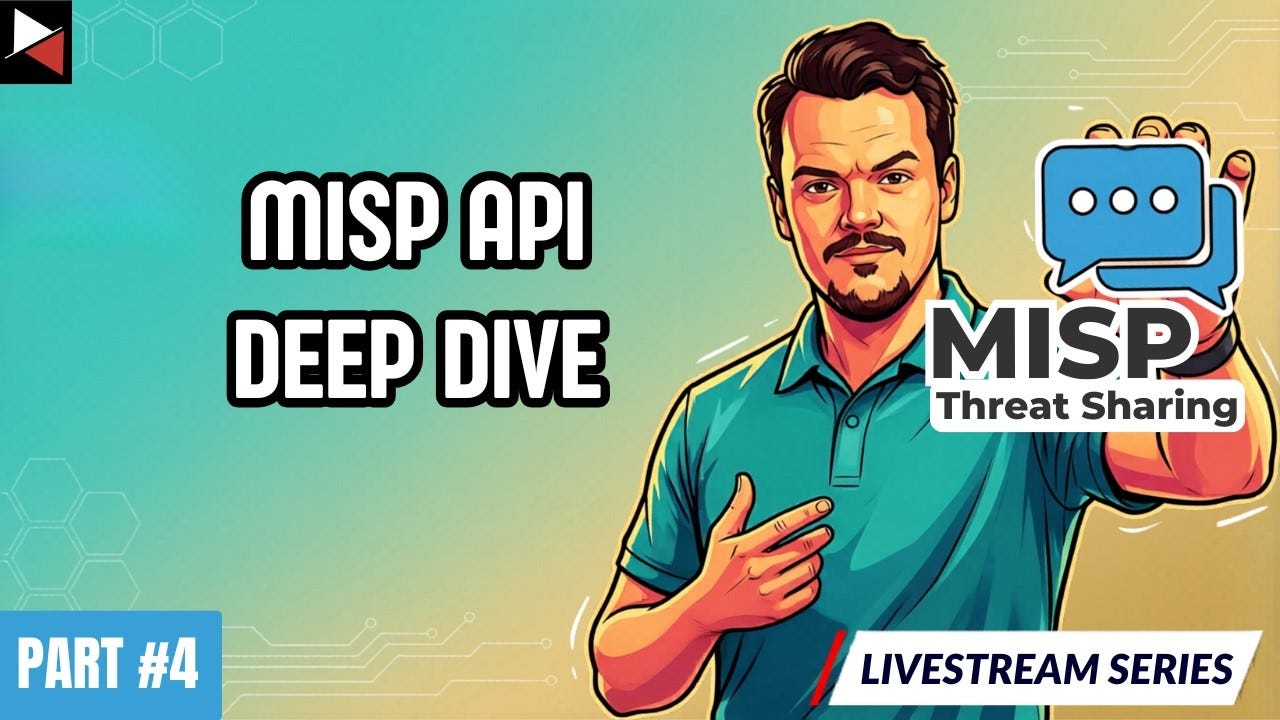
Most analysts treat MISP like a filing cabinet.
Click. Search. Copy. Paste into a detection rule. Repeat.
That works right up until you pass a dozen indicators. Then the platform stops being a force multiplier and becomes the bottleneck, and your “threat intelligence program” is really manual data entry with extra steps.
The fix isn’t more headcount. It’s the API.
In this week’s livestream, I drove the entire intel lifecycle from a Jupyter notebook with PyMISP, no clicking required:
🔎 Pull thousands of IOCs in a single query
✍️ Turn a threat report into a structured event in seconds
🛡️ Export indicators straight to Suricata / Snort / Zeek rules
⚙️ Wrap it all into a pipeline that runs while you sleep
That’s the jump from analyst to automator, and it’s a handful of lines of Python. The full notebook is yours to clone and point at your own instance.
Feature Course

What Will You Learn?
How to use Structured Analytical Techniques (SATs) to perform intelligence analysis.
What intelligence analysis technique to use and when.
Common challenges and how to overcome them.
How to practically apply analysis techniques.
Learning Resources

Cyber Training
Zero-Point Security: Advanced training in red team operations, adversary simulation, and offensive development.
TCM Academy: A comprehensive suite of courses with a hands-on, practical approach to training that equips students with the real-world skills needed to succeed in cyber.
Blue Cape Security: A specialist in Digital Forensics and Incident Response (DFIR) training, offering courses to take you from complete beginner to expert.
Tools
Octoparse: A no-code solution that will save you time, energy, and money. Let me show you how to use it to build your own custom cyber threat intelligence web-scraping tool!
The common thread isn’t AI.
The common thread is leverage.
Every attack discussed here is simply a different method of converting access into business impact.
We keep investing in visibility while attackers keep monetizing execution.
The question is not whether they get in.
The question is what authority they possess after they get in.
No unauthorized copying.
No unauthorized encryption.
No leverage.
No business interruption.
#DataFenz